POPULATION STABILIZATION
Population loss has plagued the city of Detroit, leading to abandonment, vacancy, blight and associated ills. Detroit, like other post-industrial cities, has experienced more than a half century of continuous population loss and its current population of 670,000 less than 40% of its peak population of 1.8 million in 1950. Detroit’s mayor Mike Duggan has said that population growth is the single most important metric by which to judge the health of the city.
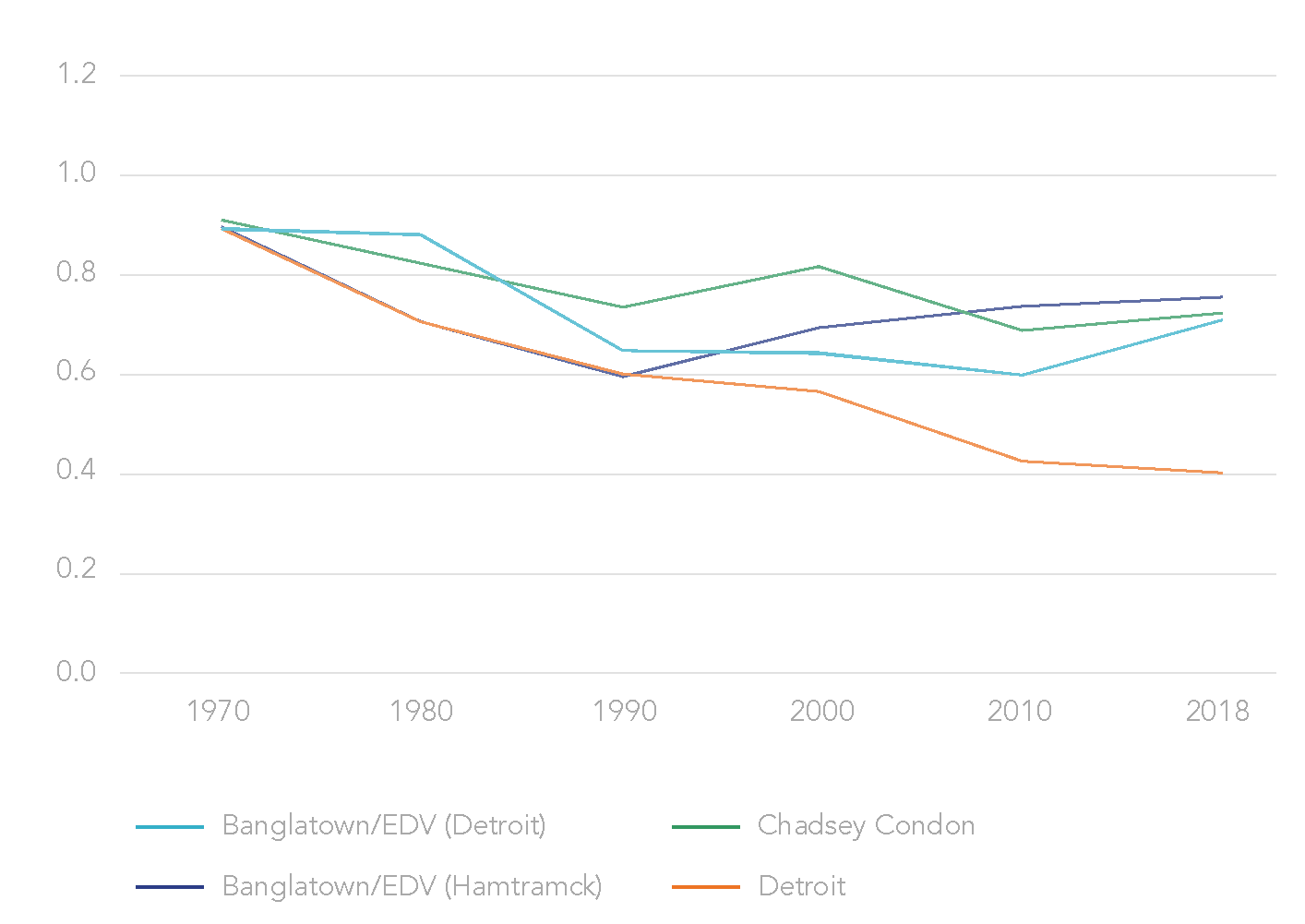
Population trends for subject areas and City of Detroit 1970 to 2018
Since 1990 the population trajectories of Banglatown/Davison and Chadsey Condon have differed sharply from the rest of the city. The overall population in these neighborhoods has stabilized as new immigrants moved into the community to replace residents who left the city or died. As a result, these two working-class neighborhoods have had stable population totals, while the city has continued to lose population over the past three decades, losing as much as a quarter of its population between 2000 and 2010 alone. Since 2010, the number of homeowners in the Detroit section of Banglatown/Davison has increased 12% and in Chadsey Condon by 15%. This is in sharp contrast to the city of Detroit, which saw a drop of more than 14,000 homeowners over the same period, with the homeownership rate falling below 50 percent for the first time since before World War II.

Global Detroit 2021
︎ ︎ ︎ ︎